


















Lin Zhanxi: A little grass conveying friendship over ten thousand miles

文:刘宇岑
“山”是宁夏西海固,“海”为沿海的福建,这是一段跨越2000多公里的对口帮扶“情”。电视剧《山海情》凌一农教授的人物原型——林占熺的故事就从这里写起。
几十年间,小小的菌草,从福建推广到宁夏,又从中国推广至全球100多个国家,成为造福全人类的“幸福草”。
巴布亚新几内亚(以下简称“巴新”)是菌草正式出海的第一个国家,如今,菌草种植已在巴新扩展到8省16区,帮助数万人脱贫。在“一带一路”倡议提出10周年之际,巴新财政和执行部长兼国家计划部长伦博·帕伊塔表示,菌草种植是中国将减贫脱贫经验应用于全球可持续发展的成功实践,巴新很骄傲能成为中国菌草走向世界的第一站。
这株“幸福草”,是以泪水与汗水为养分,以理想与坚持为雨露,以理解与信任为地基。这份幸福,来之不易。
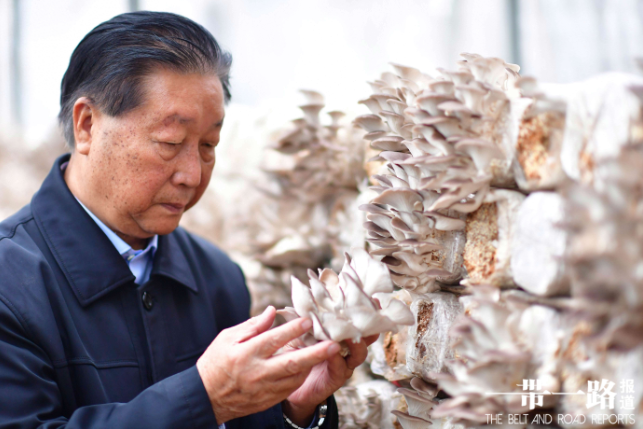
林占熺
神农尝百草
很多年后,林占熺仍然记得20世纪80年代的一个初春。他随同福建省科技扶贫考察团来到革命老区龙岩长汀县,这里山丘荒芜、植被稀疏,水土流失严重。当走进一户“五老”人家,一个小孩小心翼翼地拉着他的手讨要食物,得知这家男主人献身于革命,那晚,林占熺彻夜未眠。
救急还是救穷?林占熺曾就职于福建三明山区食用菌研发和生产基地,发展食用菌行业 “短、平、快”,如果教人用木屑培养食用菌,砍树不仅破坏生态,时间长了又会返贫,造成“菌林矛盾”,改用小麦等辅助材料做培养基,又会引发“菌粮矛盾”,都不可持续。
难道就没有一个既能让农民吃饱饭,又能保护生态的办法吗?
难题横亘眼前,看着闽西北漫山遍野的芒萁,他突然灵机一动。老区无林但有草啊,以草代木、以草代粮栽培食用菌可行吗?
长远看,这是个“一箭多雕”的办法,但在当时纯属异想天开。没钱没设备没场地,甚至相关研究资料也空缺。然而,林占熺铁了心要试一试。
家里人不理解他,他就背着家人,向学校借了5万元作为科研经费,迅速盖起了300平方米的实验室,要知道那时他全家工资也才一百来块。“正因为没有人做过,没有现成的路可走,才更需要我们去探索。”他说道。
实验首先要突破的难关是草种,仅中国就有3万多种草本植物。有的会产生副作用,有的产量偏低或质量差。经过反复测试对比,他确定了芒萁等几种野草匹配香菇菌株,进一步做实验。
等待实验结果的日夜格外漫长。3年过去了,一天晚上,同事无意中发现菌种瓶壁长出了一朵香菇,大家的疲惫瞬间一扫而空——奇迹出现了,这证明他的想法是可行的。
之后,林占熺又选用不同野草配成76个食用菌培养基配方,成功栽培出香菇、毛木耳、黑木耳等10多种食用菌,并筛选出合适芒萁、五节芒等野生菌草栽培的菌株40多种。
更令他兴奋的是,检测报告显示,通过菌草栽培的食用菌,比传统栽培食用菌的矿物质含量多出3到6倍。
学界对香菇等食用菌是木腐菌的传统理论被否定了。很快,“以草代木”的种菇技术迅速在福建许多贫困地区推广开来,林占熺和菌草“出了名”。
山海虽远,闽宁情长
1997年5月,林占熺和学生肩扛手提六箱菌草草种,来到宁夏西海固彭阳县,这是福建菌草技术帮扶宁夏的第一站。当地农民不识字,林占熺就用本地语言传授,用手把手,人盯人的办法教技术。半年后,用秸秆栽培出的香菇、平菇、双孢菇,让农户收入翻了一番还多,菌草因此得名“幸福草”。
可扶贫之外的生活却挫折不断。
20世纪80年代末,林占熺四处奔波,路上发生了车祸,头部遭猛烈撞击,不省人事;90年代,他拉来的亲弟弟林占华,在安溪县指导菌草栽培时遇到意外,不幸身亡;千禧年初,挚友、战友因病去世……这些遭遇险些击垮他。家里人起初也不理解他,女儿林冬梅在10岁时就坦言,不会走父亲的路。
“菌草业是带有全球性的一场技术革命,希望你能通过扶贫服务,为社会作贡献,实现你的生命价值。”一位前辈如此鼓励他。林占熺想起历届福建省领导相继前来调研,多位人大代表、政协委员连续多年向省两会倡议加大对菌草技术的扶持,还有多年前那双颤抖的小手,他又重新振作起来。
彭阳县菌草扶贫初战告捷,林占熺又立即辗转攻坚“吊庄”闽宁村。20多年后,这里已是“塞上小江南”。
闽宁村脱贫的宝贵经验,激励着林占熺将菌草技术传播到神州大地、五湖四海。1986年至今,菌草技术已被推广至全国31个省(区、市)的586个县,帮助数以千万计的农户脱贫致富。
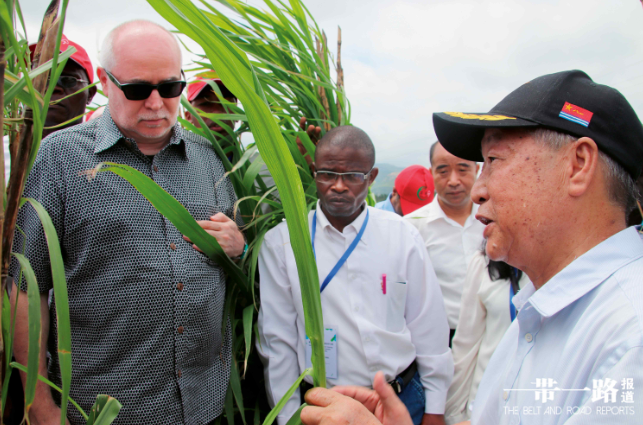
2019年6月,联合国考察团到福建省平潭县考察菌草栽培技术
另一张地图
林占熺的办公室挂着两张地图,一张是中国地图,一张是世界地图,地图上标注着一颗颗的红色五角星,那是他心中菌草技术示范的重点地区。
1996年,在首届菌草技术国际研讨会上,菌草的译名正式确认为“Juncao”。他说:“我坚持把汉语拼音作为译名,是想让世界知道,这是中国人的发明。”
2021年11月19日,习近平主席在第三次“一带一路”建设座谈会上,忆起20多年前一件往事。在福建工作期间,习近平接待了来访的巴新东高地省省长拉法纳玛。“我向他介绍了菌草技术,这位省长一听很感兴趣。我就派《山海情》里的那个林占熺去了。”
1997年夏天,林占熺带着菌草技术正式走出国门。次年巴新国庆节前夕,他种出单丛重量12.51公斤的菌草紫孢平菇,创出菌草菇之最;他还发明了一种与常规水稻、旱稻栽培技术不同的旱稻宿根栽培技术,播种一次,连续收割13次,此项成果在巴新引起轰动。
有时林占熺也会遇到相当棘手的情况,他却不动声色化干戈为玉帛。
2005年,在卢旺达,由于新到任的农业与动物资源部部长不太喜欢菌草项目,谈好的项目面临撤销。林占熺“曲线救国”,回到福建农林大学办起了菌草技术国际培训班,邀请卢旺达国际友人前来听课,通过课程,建立了口碑,就连最初不看好的那位部长也被打动。2008年,援卢旺达农业技术示范中心立项,林占熺为项目具体负责人。
2007年,林占熺一行在莱索托遭遇劫匪,行囊被翻了个底朝天。事后,专家组萌生退意,但林占熺认为,劫匪之所以没有伤人,是因为知道他们是中国援助人员。稳定军心后,专家组又迎来胜利。短短88天,改变了无数妇女与青年的命运。
“他就是一个无私的人。”他的女儿、战友、助手林冬梅对本刊记者说道。有多无私呢?在他一贫如洗、身负巨债时,国外希望高价收购专利,他也没有动心,而是与大众无私分享,倾囊相授。
继承人
在宁夏的沙漠中,林冬梅的手机信号很差,时不时会断开。一旦开始工作,她就会进入忘我状态,这一点,和她父亲挺像的。
女儿成长为父亲的继承人,是一个漫长的过程。
林冬梅上小学时,父亲借5万元搞研究;读中学时,父亲为让世人知道中国人的发明,借3万元远赴瑞士;父亲还让菇农搬到家里吃住,母亲料理一切家务,一家人日子过得紧巴巴。1992年,林冬梅刚考上厦门大学,便被选中留学新加坡,一走就是11年。
巴新那几年,只有父亲在新加坡机场转机时,父女俩才能匆匆一见。每一次相见,父亲都比上一次更苍老了。林冬梅突然意识到,身为儿女的义务与责任。2003年,她放弃了新加坡的高薪工作和永久居住权,投身于父亲的事业中。之后,父女二人把全世界最贫穷落后的地区几乎走了个遍。
林冬梅看到了世界的另一面。不是所有人都幸福,但因为菌草,南非单亲妈妈们开始学习种菇,收入提高了,她们可以把孩子送进学校,不再重复自己的命运。林冬梅越来越理解父亲。
2017年5月26日,父女二人共同出席中国—联合国和平与发展基金菌草技术项目研讨会,见证具有历史意义的时刻:菌草技术被联合国列为中国—联合国和平与发展基金重点项目,并宣告正式启动。
此后,联合国的“菌草热”,一波接一波。2019年4月18日,联合国菌草技术高级别磋商会议在美国纽约联合国总部举行。埃斯皮诺萨主席开门见山地说:“菌草技术是中国‘一带一路’倡议的象征,中国通过菌草技术讲述了一个伟大故事,在福建点燃的火花显示出技术创新的巨大潜力,如果对一项创新善加培育并部署得当,就能改善世界各地人们的生活状况。”
在“一带一路”倡议提出10周年之际,林占熺、林冬梅父女二人及团队仍然奔赴在一线,和小小菌草一样,展示着顽强的生命力。
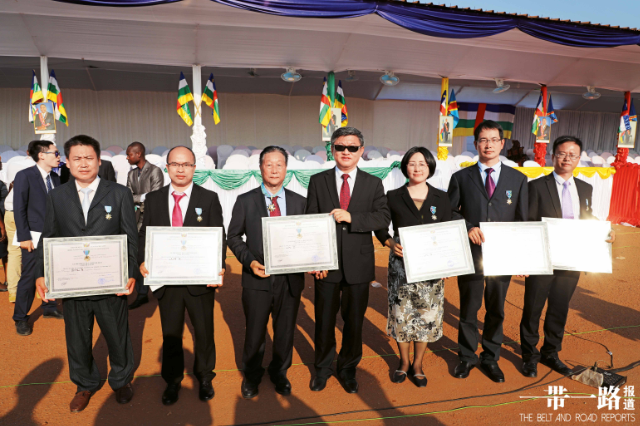
2019年,林占熺等6名中国菌草技术专家获颁中非共和国国家感谢勋章
the “mountain” refers to Xihaigu in Ningxia, the “sea” refers to the coastal Fujian Province which is over 2,000km away from Xihaigu, and the “friendship” refers to the pairing assistance from Fujian to Xihaigu. This is the story of Lin Zhanxi, the real-life inspiration behind the character of Professor Ling Yinong in the TV drama “Minning Town” of which the Chinese name literally means “mountain-sea friendship”.
Over the past few decades, Juncao has been promoted from Fujian to Ningxia and then from China to more than 100 countries around the world, becoming a “prosperity grass” that benefits all mankind.
This “prosperity grass” is nourished by tears and sweat, with ideals and persistence as the rain and dew and based on understanding and trust. The prosperity is hard-won.
The spirit of Shennong
Even after so many years, Lin Zhanxi still remembers that, in an early spring in the 1980s, he accompanied a scientific and technological poverty alleviation delegation of Fujian Province to Changting County, Longyan City, an old revolutionary base area where hills were barren, vegetation was sparse, and soil erosion was serious. When they visited a “five-veteran” family – veteran underground party members, veteran guerrilla fighters, veteran underground messengers, veteran liaison contacts, and veteran rural cadre in the former Chinese Soviet Area – a child bashfully took Lin Zhanxi’s hand to beg for food. Lin Zhanxi was told that the backbone of the family died for the cause of the revolution and could not fall asleep at all that night.
Is the most suitable solution emergency relief or poverty alleviation? Lin Zhanxi once worked in the R&D and production base of edible fungi in the mountain area of Sanming City, Fujian Province. The industrial development of edible fungi features short planting cycles, low investment requirements, and high effectiveness, but if people are taught to use sawdust to cultivate edible fungi, tree felling will not only destroy the ecology but also lead to poverty over time, resulting in a “fungus-forest contradiction”. If wheat and other auxiliary materials are used as the medium, there will be a “fungus-grain contradiction”, which will also jeopardize sustainable development.
Looking at the mountains and fields covered by forked ferns in northwest Fujian Province, Lin Zhanxi suddenly had an idea: What about using grass instead of wood and grain to cultivate edible fungi in this area where there was no forest but grass?
In the long run, this would be a “multiple-shot” approach, but at that time it was just a fantasy, as there was no money, no equipment, no space, and even no relevant research material. However, Lin Zhanxi was determined to have a try.
His family didn’t understand him, so he borrowed RMB 50,000 from the school as a scientific research fund without telling his family and quickly built a 300-square-meter laboratory. At that time, the household income of his family was only about RMB 100.
The first challenge in the experiment was to find a suitable grass variety. China alone has more than 30,000 types of herbaceous plants. Some plants can cause side effects and some will lead to low yield or poor quality. After repeated tests and comparisons, he decided to further his experiment by using several wild grass varieties such as forked ferns for the cultivation of shiitake mushrooms.
Lin Zhanxi could not wait to see the experiment results and felt that the days and nights were particularly long while waiting. Three years later, his colleague accidentally found a shiitake mushroom one night on the wall of the strain flask, and everyone’s exhaustion was instantly swept away – this miraculous result proved the feasibility of Lin Zhanxi’s idea.
More excitingly, test reports showed that the edible fungi cultivated by using Juncao have three to six times more mineral content than those traditionally cultivated.
Soon after the traditional academic opinion that defined edible fungi such as shiitake mushrooms as wood-destroying fungi was denied, the mushroom planting technology that replaces wood with grass was quickly promoted in many poverty-stricken areas in Fujian Province. Lin Zhanxi and Juncao became famous.
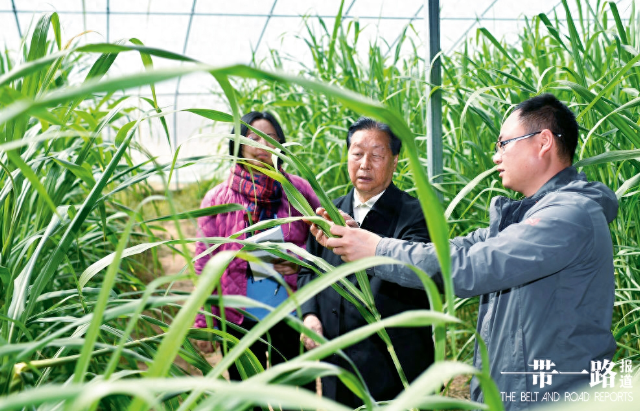
林占熺带领菌草国际班学员识别菌草品种的生物学特性
The friendship between Fujian and Ningxia distance transcends long distance
In May 1997, Lin Zhanxi and his students carried six boxes of Juncao to Pengyang County, Xihaigu, Ningxia, the first stop of Fujian’s Juncao technique in assisting Ningxia’s poverty alleviation. The local farmers were illiterate. Therefore, Lin Zhanxi taught them in the local language, hand-in-hand and person-to-person. Half a year later, the income of the farmers more than doubled due to the cultivation of shiitake mushrooms, oyster mushrooms, and white button mushrooms with straw. Since then, Juncao has been known as the “prosperity grass”.
But Lin Zhanxi’s life outside poverty alleviation was frustrating.
In the late 1980s, Lin Zhanxi went into a coma after injuring his head in a car accident; in the 1990s, his brother Lin Zhanhua died accidentally while guiding the cultivation of Juncao in Anxi County; At the beginning of the millennium, his close friend and comrade-in-arms died of illness... These unfortunate encounters nearly crushed him. His family also didn’t understand him at first. His daughter Lin Dongmei admitted when she was 10 that she would not follow her father’s path.
“The Juncao technique represents a global technological revolution. I hope you can contribute to society and realize your life value through poverty alleviation services”, an elder encouraged him so. Lin Zhanxi recalled the visits paid by the leaders of Fujian Province, the proposals that many deputies to the provincial People’s Congress and members of the provincial committee of the Chinese People’s Political Consultative Conference had put forward in the provincial Two Sessions for many consecutive years to support Juncao technology, and the small trembling hands that took his hand a few years ago. With these thoughts, he picked himself up again.
After the first victory of applying Juncao technique to poverty alleviation in Pengyang County, Lin Zhanxi immediately went to Minning Village, a village built based on migration. Some 20 years have passed and Minning Village has become a “small place of abundance”.
The valuable experience of Minning Village in poverty alleviation has inspired Lin Zhanxi to spread the Juncao technique across China. Since 1986, the Juncao technique has been promoted to 586 counties in 31 provinces, autonomous regions, and municipalities across China, helping tens of millions of rural households get rid of poverty and become rich.
Another map
Lin Zhanxi has two maps hanging in his office. One of them is a map of China and the other is a map of the world. The maps are marked with red five-pointed stars indicating the key Juncao technique demonstration areas in his plan.
In 1996, at the first international symposium on Juncao technology, the English name of the technology breeding fungi with herbaceous plants was officially confirmed as “Juncao”. Lin Zhanxi said, “I insisted on using Chinese Pinyin as the name used in translation because I wanted the world to know that the technology was an invention of China.”
On November 19, 2021, at the third symposium on the Belt and Road Initiative, President Xi Jinping mentioned an event that happened some 20 years ago. As the then governor of Fujian Province, Xi Jinping received Peti Lafanama, the visiting Governor of Papua New Guinea’s Eastern Highlands Province. “I introduced him to the Juncao technique and he was very interested in it. So I sent Lin Zhanxi, the real-life inspiration of the TV drama ‘Minning Town’ to Papua New Guinea.”
In the summer of 1997, Lin Zhanxi brought the Juncao technology abroad for the first time. In the following year, on the eve of the National Day of Papua New Guinea, the black oyster mushroom he planted reached 12.51kg per cluster, creating a record high in fungus cultivation using the Juncao technique. He also invented a perennial upland rice cultivation technique which is different from conventional rice and upland rice cultivation techniques, allowing 13 consecutive harvests after sowing once, which caused a sensation in Papua New Guinea.
Lin Zhanxi also encountered some difficult situations, but he solved the problems in a peaceful way.
In 2005, in Rwanda, the new Minister of Agriculture and Animal Resources did not like the Juncao project, which made it impossible for the agreed project to proceed. To solve the problem, Lin Zhanxi returned to Fujian Agriculture and Forestry University to hold an international training program on Juncao technology and invited international friends from Rwanda to attend the classes. In this way, he established a good reputation. Even the minister who did not support the Juncao project at first was persuaded. In 2008, the China-aided Agricultural Technology Demonstration Center in Rwanda was approved, with Lin Zhanxi as the project leader.
“He is a selfless man.” His daughter, comrade-in-arms, and assistant Lin Dongmei said to our reporter. How selfless is he? When he was destitute and heavily in debt, there were foreigners offering a large sum of money for the patent, but he was not tempted and shared the technology with the public selflessly.
The successor
In the desert of Ningxia, Lin Dongmei’s cell phone reception is so poor that disconnection happens from time to time. Lin Dongmei resembles her father in the way she is absorbed once she starts to work.
It is a long process for a daughter to grow into a successor to her father.
When Lin Dongmei was in primary school, her father borrowed RMB 50,000 for research; when she was in secondary school, her father borrowed RMB 30,000 to go as far as Switzerland to let the world know about China’s invention. Her father even asked mushroom farmers to move in with their family, while her mother took care of all housework and the family lived a tight life. In 1992, Lin Dongmei was selected to study in Singapore as soon as she received an acceptance letter from Xiamen University. She went to Singapore and stayed there for 11 years.
In the years when Lin Zhanxi was promoting the Juncao technology in Papua New Guinea, Lin Dongmei could only meet her father hurriedly when her father stopped in transit at the Singapore airport. Every time they met, Lin Dongmei felt that her father looked older than the last time. She suddenly realized her duty and responsibility as a daughter. In 2003, she gave up her well-paid job and permanent residence in Singapore to work with her father. Since then, the father and daughter have visited almost all of the world’s poorest and most underdeveloped areas.
Lin Dongmei has seen the other side of the world. Not everyone lives a prosperous life, but because of the Juncao technology, single mothers in South Africa can learn to grow mushrooms to increase their incomes so as to send their children to school and prevent them from repeating the unfortunate fate. Lin Dongmei has understood her father better and better.
On May 26, 2017, the father and daughter attended the Workshop on Juncao Technology Project of China-UN Peace and Development Trust Fund and witnessed a historic moment: Juncao technology was listed as a key project of China-UN Peace and Development Trust Fund by the United Nations and the project was officially launched.
Since then, there have been several rounds of “Juncao rush” at the United Nations. On April 18, 2019, the High-Level Meeting on Juncao Technology was held at the United Nations Headquarters in New York, the United States of America. Mrs. María Fernanda Espinosa Garcés, President of the 73rd Session of the UN General Assembly, cut to the chase at the meeting, “Juncao technology is emblematic of China’s Belt and Road Initiative. Through Juncao technology, China has a great story to tell. The spark lit in Fujian Province has shown the potential of a single innovation – if nurtured and deployed wisely – to change lives and improve livelihoods across the world.”
On the 10th anniversary of the Belt and Road Initiative, Lin Zhanxi, Lin Dongmei, and their team are still on the front line, showing tenacious vitality like Juncao.
来源:《一带一路报道(中英文)》2023年10月特刊
【未经授权,严禁转载!联系电话028-86968276】